Genetic Testing: The Unseen Lifesaver
“Eliminating the variables of health through rigorous DNA screening and data-driven pairings.”
Genetics can be incredibly interesting, but let's be honest—they are also very confusing if you aren't familiar with them! You may be wondering what it means when a puppy has the potential to be "clear" or a "carrier" for a disease, or you may not have even realized that was something breeders look for.
Is it an Acceptable Pairing?
YES
YES
Yes
NO
NO
Is it an Acceptable Pairing for PGF?
YES
YES
NO
NO
NO
"Why not just breed 'Clear' dogs only?"
There is no reason to artificially limit the gene pool by only breeding Clear dogs. If a Carrier dog is otherwise spectacular, removing them shrinks the gene pool and might accidentally eliminate fantastic traits! As responsible breeders trying to better the breed overall, we have to look at the whole picture: pedigree, OFA clearances, temperament, structure, and working drive. As long as a Carrier is paired with a Clear, no puppies are ever in danger of being affected.
Common Golden Retriever Genetic Diseases
The following are the top five genetic diseases for Golden Retrievers of concern and here at PGF, we ensure any potential mate to our dogs has been tested for these markers at a minimum. We test our dogs using Embark which actually tests for 273 genetic markers! Even if you do not pick PGF as your breeder, please ensure the breeder you select is doing their part to protect the Golden Retriever breed by asking for copies of the puppy parent’s genetics. If they refuse that request, please consider another breeder.
Ichthyosis (ICH / ICT)
Commonly referred to as "Fish Scale Disease," this condition prevents the outer layer of the skin from forming properly. It results in darkened, thick skin with excessive flaking (similar to heavy human dandruff). It is very common in Golden Retrievers and symptoms usually show up before the puppy's first birthday.
Note on Skin Issues: Goldens have thick double coats and floppy ears, making them naturally prone to hot spots or dry skin depending on climate, diet, and grooming. Just because a dog is flaky does not automatically mean they have ICH! We test all our dogs to ensure we never produce an affected puppy. We recommend high-quality grooming products like Life's Abundance to keep their coats healthy.
Muscular Dystrophy (MD)
This results from a lack of dystrophin, a protein necessary for proper muscle function. This causes progressive muscle degeneration. Symptoms generally start showing between 6 to 8 weeks of age and include difficulty swallowing, an enlarged tongue, difficulty breathing, excessive drooling, and general muscle weakness. There is no cure, making screening critical.
Degenerative Myelopathy (DM)
This is a spinal cord disease similar to ALS in humans that typically shows up in older dogs (between 8 and 14 years old). It results in a slow loss of coordination in the hind limbs, leading to wobbling, dragging paws, and eventual paralysis. There is no cure.
Progressive Retinal Atrophy (PRA 1, PRA 2, and prcd-PRA)
PRA is the canine equivalent of retinitis pigmentosa in humans. It causes the photoreceptor cells in the retina to slowly degenerate, eventually leading to complete, painless blindness. There is no treatment or cure.
Neuronal Ceroid Lipofuscinosis (NCL)
NCL is a severe hereditary neurodegenerative disorder where lipopigments build up excessively in the body's tissues, damaging nerve cells. First symptoms usually appear around 15 months of age and include anxiety, constant circling, tremors, aggression, seizures, and visual impairment. There is no cure or treatment.

Our Commitment to Total Transparency
At Pine Grove Farm, we believe in data, not guesswork. While our strategic pairings guarantee that no puppy will ever be Affected by these diseases, we want our families to have the full picture of their dog's genetic makeup.
To ensure this, we perform a full genetic DNA panel on every single puppy in the litter before they leave our care.
By testing at the 21 - 28 day mark, we provide our families with a certified status report (Clear or Carrier) for every disease on the Golden Retriever panel - before our puppies go home. For the pet owner, this offers ultimate peace of mind. For the future breeder or sportsman, it provides the essential data needed to plan for the next generation. We don't just guarantee a healthy puppy; we provide the documentation to prove it.
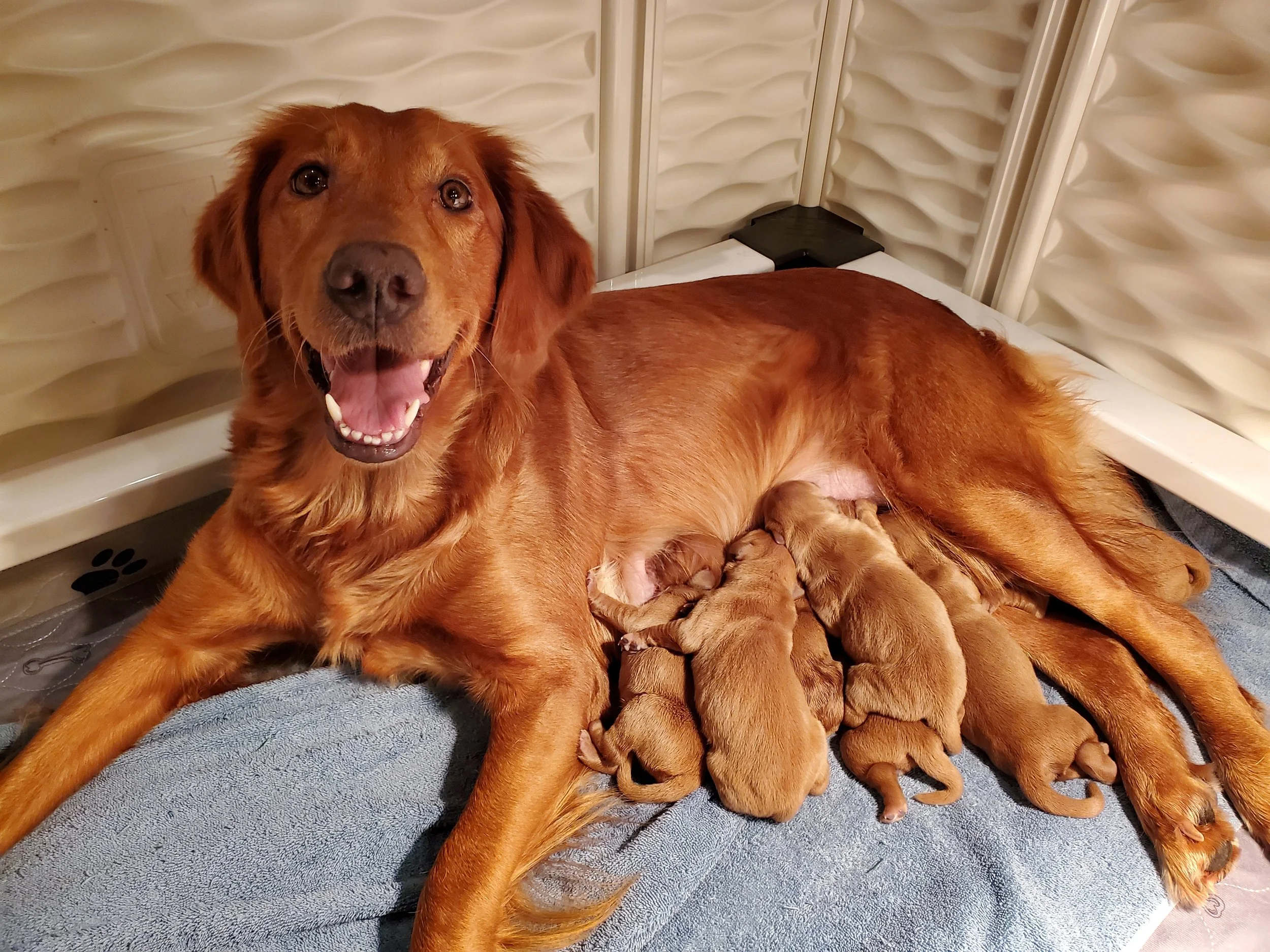
For a responsible preservationist, genetic DNA testing isn’t a luxury—it is the foundation of the entire program. We do our homework long before a pairing ever takes place, meticulously mapping out pedigrees to ensure that these recessive diseases remain 100% avoidable. Whether you are seeking a loyal family companion or a future prospect for your own breeding program, this data-driven approach ensures that health is never left to chance. At Pine Grove Farm, we don't just hope for healthy puppies; we engineer the pairings that guarantee them.
Understanding the Terms: Clear, Carrier, and Affected
The common Golden Retriever genetic diseases listed below are all recessive. This means a dog has to inherit two copies of the mutated gene (one from the mom, one from the dad) to actually be affected by the disease.
Clear (No mutated genes): The dog does not have the gene, will never get the disease, and cannot pass it on.
Carrier (1 mutated gene): The dog has just one copy of the gene. There is absolutely nothing wrong with a carrier. They do not have the disease, nor will they ever show signs or symptoms of it. Period.
Affected (2 mutated genes): The dog inherited the gene from both parents and will actively be affected by the disease.
As a pet owner, all you need to know is that Clears and Carriers are equally great choices because neither will ever be sick with that disease. As a breeder, it simply means that if you have a Carrier dog, you must only breed them to a Clear dog to guarantee you never produce an Affected puppy.
The Breeding Math
Here is how the genetics break down based on the parents you pair up:
100% Affected
How and Where to Test
You don’t even need a vet for this! Genetic testing can be done at home at any age using a simple cheek swab kit mailed to a lab.
We personally use and recommend Embark because they have a rapid turnaround time, great customer service, and their full panel costs roughly $140. When you look at the potential vet bills of treating a dog with a lifetime genetic disease, skipping this test to save a few bucks makes zero sense.
Other reputable labs to check out include:
Animal Genetics
Embark
Wisdom Health (Optimal Selection)
Orivet
PawPrint Genetics
Dam & Sire Pairing
Clear & Clear
Clear & Carrier
Clear & Affected
Carrier & Carrier
Affected & Affected
What it Produces per Litter
100% Clear
50% Clear / 50% Carrier
100% Carrier
25% Clear / 50% Carrier / 25% Affected